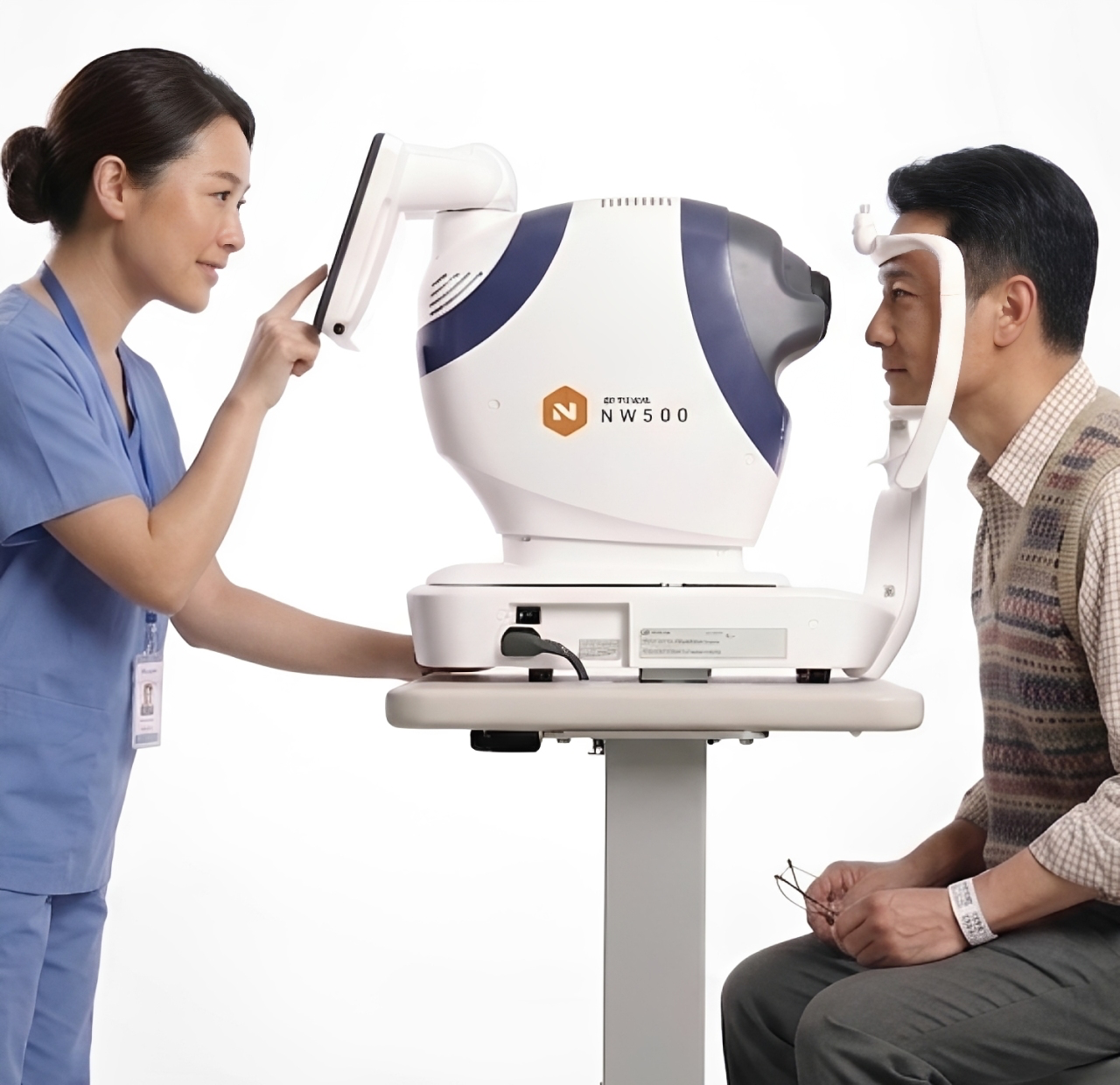
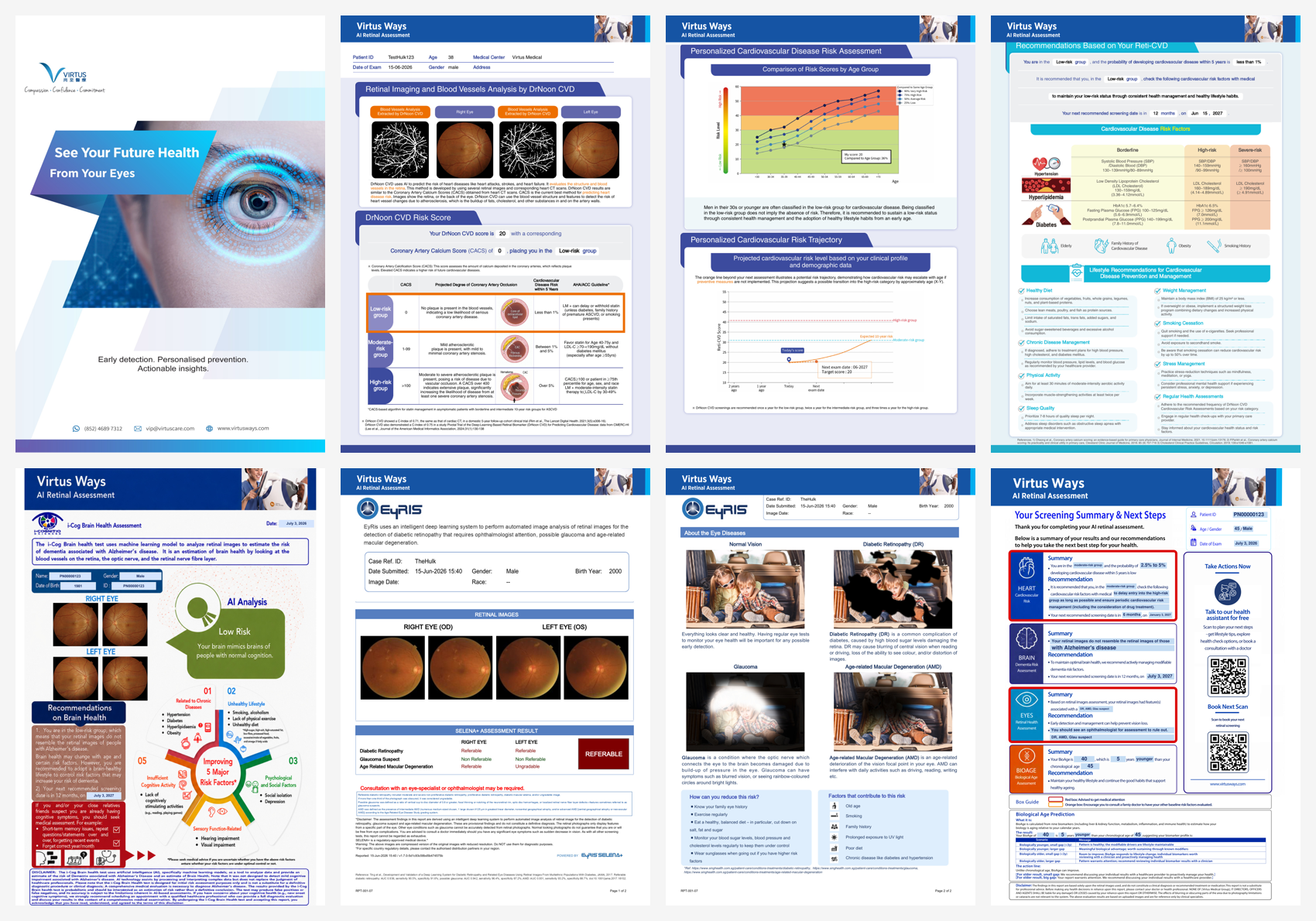
Four evidence-based clinical screening engines work together to provide a comprehensive, science-backed view of your internal health.
心血管疾病風險Cardiovascular Risk
冠心病風險分層輔助工具
Coronary Heart Disease Risk Stratification Support Tool
透過非侵入性眼底微血管動態追蹤,優於現有的心血管疾病事件風險分層方法,有潛力作為 CACS 的替代測量方法,評估未來某些心血管疾病。
臨床效益:研究證實,透過深度學習(AI)與視網膜攝影所計算出的評分,在預測心血管事件的表現上,媲美傳統電腦斷層(CT)的檢測結果。數據表明,此項技術極具潛力成為評估心血管疾病風險的全新替代方法。
Utilizing non-invasive tracking of retinal microvascular dynamics, this method outperforms certain existing cardiovascular event risk stratification approaches. It holds significant potential as an alternative measurement to the Coronary Artery Calcium Score (CACS) for evaluating future cardiovascular disease risks.
Clinical Benefit: The study demonstrated that the score calculated through deep learning (AI) and retinal photography achieved performance comparable to traditional computed tomography (CT) results in predicting cardiovascular events. The data indicate that this technology has strong potential as a new alternative method for assessing cardiovascular disease risk.
學術文獻Academic Literature
腦健康風險Brain Health Risk
腦健康和神經生物指標篩查
Brain Health & Neuro-Biomarker Screening
從視網膜微細的神經結構退化可以推測早期認知障礙,比如阿茲海默病。
臨床效益:基於視網膜攝影的深度學習(AI)演算法能以高準確度檢測阿茲海默症,展現出在社區型篩查中應用的強大潛力。
Evaluates subtle degenerative changes in retinal neural structures, which are closely linked to early cognitive impairments such as Alzheimer’s disease.
Clinical Benefit: Deep-learning algorithms based on retinal photographs can detect Alzheimer’s disease with good accuracy, demonstrating strong potential for community-based screening.
學術文獻Academic Literature
眼疾風險Eye Disease Risk
隱形視力殺手精準篩查
Precision Screening for Silent Vision Killers
以高敏感度的快速篩查方法,及早辨識包括糖尿病視網膜病變、青光眼及黃斑退化等潛在視力風險。
臨床效益:在這項針對多元種族糖尿病患者群體的視網膜影像評估中,深度學習系統(DLS)在識別糖尿病視網膜病變及相關眼科疾病方面,展現出高度的敏感性與特異性。
A rapid screening method with high sensitivity: it enables early identification of potential vision-threatening risks, including Diabetic Retinopathy, Glaucoma, and Macular Degeneration.
Clinical Benefit: In this retinal image assessment within a multi-ethnic cohort of patients with diabetes, the deep learning system (DLS) demonstrated high sensitivity and specificity in identifying diabetic retinopathy and related ocular diseases.
學術文獻Academic Literature
生物年齡Biological Age
細胞生物學年齡評估
Biological Age Assessment
測算您的真實生理年齡,並對比實際日曆年齡,協助制定個人化的抗衰老管理規劃。
臨床效益:該研究基於深度學習開發的新型生物學年齡標誌物,可以作為預測死亡率和發病率的指標,並可作為一種非侵入性方法來評估生物年齡。
To derive your biological age based on deep learning of retinal biomarkers as compared to your chronological age. To assist in the formulation of a longevity management plan.
Clinical Benefit: The novel biological age biomarker developed based on deep learning serves as an indicator for predicting mortality and morbidity, and offers a non-invasive approach to assessing biological age.
學術文獻Academic Literature
-
Gunasekeran DV, Miller S, Hsu W, et al.
National Use of Artificial Intelligence for Eye Screening in Singapore.
NEJM AI. 2024.
doi:10.1056/AIcs2400404.
此案例研究介紹 SELENA+ 在新加坡全國糖尿病視網膜病變篩查中的部署與真實世界表現。
This case study describes national deployment and real-world performance of SELENA+ for diabetic retinopathy screening in Singapore.
-
Cheung CY, Ran AR, Wang S, et al.
A Deep Learning Model for Detection of Alzheimer’s Disease Based on Retinal Photographs: A Retrospective, Multicentre Case-Control Study.
The Lancet Digital Health. 2022;4:e806–e815.
doi:10.1016/S2589-7500(22)00169-8.
研究顯示,深度學習可利用視網膜照片辨識阿茲海默症相關訊號,並於多中心資料中測試。
The study shows that deep learning can identify Alzheimer’s disease-related signals from retinal photographs and was tested across multiple centres.
-
Rim TH, Lee CJ, Tham YC, et al.
Deep-Learning-Based Cardiovascular Risk Stratification Using Coronary Artery Calcium Scores Predicted from Retinal Photographs.
The Lancet Digital Health. 2021;3:e306–e316.
doi:10.1016/S2589-7500(21)00043-1.
研究以視網膜照片推算冠狀動脈鈣化風險,並評估其在心血管風險分層中的應用。
The study used retinal photographs to estimate coronary artery calcium-related risk and evaluated its role in cardiovascular risk stratification.
-
Nusinovici S, Rim TH, Li H, et al.
Application of a Deep-Learning Marker for Morbidity and Mortality Prediction Derived from Retinal Photographs: A Cohort Development and Validation Study.
The Lancet Healthy Longevity. 2024;5:100593.
doi:10.1016/S2666-7568(24)00089-8.
研究介紹 RetiPhenoAge,一種由視網膜照片推算的深度學習生物年齡標記。模型以 UK Biobank 資料開發,並於新加坡及美國外部驗證,顯示可預測生物年齡、心血管疾病、發病率及死亡率。
Introduces RetiPhenoAge, a deep learning-based biological ageing marker derived from retinal photographs. The model was developed using UK Biobank data and externally validated in Singapore and the USA, demonstrating strong prediction of biological ageing, cardiovascular disease, morbidity, and mortality.
-
Cho J, Seo J, Park J, et al.
The Distribution of Artificial Intelligence–Derived Retinal Cardiovascular Risk Scores and Conventional Risk Factors in Two Korean Health Screening Cohorts: A Descriptive Study.
Cardiovascular Prevention and Pharmacotherapy. 2025;7(3):73–84.
doi:10.36011/cpp.2025.7.e14.
研究分析逾 13.8 萬名受檢者,顯示 AI 視網膜心血管風險分數與年齡、傳統危險因子及冠狀動脈鈣化相關。
This study analysed more than 138,000 participants and found that AI-derived retinal cardiovascular scores were associated with age, conventional risk factors, and coronary artery calcium.
上述研究支持 AI 視網膜影像在糖尿病視網膜病變、腦健康及心血管風險篩查中的潛在用途。篩查結果不等同臨床診斷,應由醫護專業人員結合個人情況作出解讀。
These studies support the potential use of retinal AI for diabetic retinopathy, brain-health, and cardiovascular-risk screening. Screening results are not a clinical diagnosis and should be interpreted by qualified healthcare professionals in context.